
AA’s Members: Why and How We Cooperate with Professionals
Extending the hand of Alcoholics Anonymous has been our primary function since A.A.’s inception in 1935 – including outreach to our valued friends in all professional fields. Early on, these associations have proven to be mutually beneficial and completely in keeping with the A.A. Traditions. As such, Alcoholics Anonymous formed the CPC committee, Cooperation with the Professional Community. CPC’s sole mission is to familiarize Professionals with what A.A. is and what A.A. does.
Origin and Purpose of CPC
CPC came into being as a distinct entity in 1970 as an outgrowth of the Public Information Committee. In 1971, the Conference CPC Committee was established. Members of CPC committees inform Professionals and future Professionals about A.A. — what we are, where we are, what we can do, and what we cannot do. They attempt to establish better communication between A.A.s and Professionals and to find simple, effective ways to cooperate without affiliating.
CPC Work and Why A.A.s Do It
Cooperating with nonalcoholic Professionals is an effective way to carry the message to the sick alcoholic. Such people often meet the alcoholic in places where A.A. is not present. Through Professionals, alcoholics may be reached who might otherwise never find the program, or they may be reached sooner with the help of informed non-A.A.s.
(Cooperation with the Professional Community Workbook, pg 5; Copyright © by A.A. World Services, Inc.; reprinted with permission.)
How Do A.A.s Reach Out to Professionals? What Information Do A.A.s Share?
Methods of outreach continue to grow as new means of communicating develop through technological advancement. The means employed by any CPC committee depends on the members’ availability, skills and desires. Some examples of outreach are:
- Contact local Professionals and offer to provide informational literature and/or A.A. presentations. Contact, most commonly can be by phone, email, snail mail, social media and even in-person “cold calls”.
- CPC can begin with the professionals who know you. See the reference to Language of the Heart (page 15) below. Start your CPC work with professionals who know your journey.
- Arrange for A.A. literature to be available in their waiting rooms and develop a plan for how to keep the literature stocked.
- Direct professionals to the Area26 (insert link) and GSO (insert links) CPC Webpage.
- Let Professionals know that A.A.’s CPC committee is available as a resource.
- Invite Professionals and professional students to attend an open meeting.
- Invite local Professionals to a breakfast, luncheon or informational event involving a presentation explaining how A.A. can be a resource and explaining what A.A. is and is not.
- Staff an A.A. informational table at events, meetings, conferences, etc. sponsored by Professionals and/or professional organizations.
- Provide copies of the A.A. Grapevine and La Vina. Encourage the professional community to read the stories and identify individuals they are responsible for in the stories they read.
- Share the LinkedIn and Grapevine/La Vina Instagram pages
CPC Committees Reach Out Tools
CPC Guidelines: A.A. Guidelines on Cooperation With the Professional Community | Alcoholics Anonymous
CPC Workbook: Cooperation with the Professional Community (CPC) Workbook | Alcoholics Anonymous
CPC Toolkit: Contents of CPC Kit List | Alcoholics Anonymous
Suggestions for using Grapevine and La Vina: F-190 – Suggestions for Using Grapevine and La Viña
Have questions?
Email our Area 26 CPC Committee chair: [email protected]
PI & CPC National Workgroup
The National PI & CPC group is made up of interested A members along with a host of current and past PI and CPC chairs and service folks.
Each month, AA members from around the country meet to discuss their experiences. The group chairs typically schedule a topic presentation for the group. This is an amazing resource for AAs interested in becoming more involved in PI &CPC.
The goal is to improve the AA message of recovery in the public square.
Topics include
- The Quarterly AA Nurses group workshop
- AA and technology – video creation, social media, google ads.
- Church, University and Nurses campaigns.
- Using AI tools for communication.
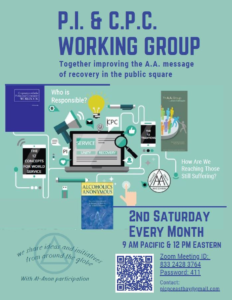
The P.I. & C.P.C. Working Group
Date: Second Saturday of Every Month
Event Time: 12:00pm – 1:00pm EST
Please Contact The CPC Committee Chair for more information
Zoom ID: 833 2428 3764
Passcode: 411
Anonymity at the Public & Personal Levels
In The Language of the Heart, Bill writes, “Our whole public relations policy, contrary to usual customs, should be based upon the principle of attraction rather than promotion.” In the pamphlet “A.A. Tradition: How It Developed” (page 47), he stated: “We ought not disclose ourselves to the general public through the media or the press, in pictures or on the radio.” (This would also, these days, include digital or social media.)
(Copyright © by A.A. World Services, Inc.; reprinted with permission.)
In The Language of the Heart (page 15), Bill further writes: “It should be the privilege of each individual A.A. to cloak himself with as much personal anonymity as he desires.” At the personal level anonymity provides protection for all members from identification as alcoholics, something newcomers may particularly desire. However, in doing C.P.C service work — such as giving presentations to those in a professional field — an A.A. member may be asked for his or her first and last names. This is not an anonymity break because it is not on a level of press or media, and because an A.A. member doing this type of service work is also doing Twelfth Step work. However, if, as an A.A. member, you are uncomfortable with this, then perhaps another form of service might be a better fit for you.
(Copyright © by AA Grapevine Inc.; reprinted with permission.)
Technology in Alcoholics Anonymous – PI/CPC Community Category
Latest PI – CPC Committee topics – Technology in AA Online Community
The Modern ‘Doctor’s Opinion
A new Cochrane Review (March 2020) finds Alcoholics Anonymous and 12-Step Facilitation programs help people to recover from alcohol problems.
Why do CPC Committee members care about this review?
This is competent source for our health professionals to understand the effectiveness of AA. Its our “new” Doctor’s Opinion. Share with Health Professionals
What is a Cochrane Review?
A Cochrane review is a systematic review of research in health care and health policy, recognized as the gold standard in evidence-based healthcare.
What did this review produce?
AA/TSF participants were 20-60% more likely to become and remain abstinent than cognitive behavioral therapy (CBT), motivational enhancement therapy (MET) and other treatments alone.
AA/TSF participants are more likely to be Employed, have Job Satisfaction, Take fewer Sick Days, Have fewer Accidents, Earn higher wages, Have lower Employee costs…than the General Public.